
The Science of Caring WellSeptember 8, 2026 · 12 min read

I have been mentored badly by generous people and mentored well by people who had very little time for me. If I am being honest, I have probably also been both types of mentors as well. The difference was never warmth, and it was never seniority. The difference was function.
The generous ones told me stories about their careers. The effective ones did something more specific. They figured out who I actually was, they explained the system I was standing in, and then they picked up the phone. Three distinct jobs. Most people who volunteer as mentors are only good at one of them, and almost nobody names which one.
That is the problem with "mentorship" as a word. It is a container term. It gets applied to a lunch, a formal program, a signature on a form, and a twenty-year relationship that changed someone's life. When a construct covers everything, it predicts nothing, and the research reflects that. The largest multidisciplinary meta-analysis in the field found that mentoring is associated with a broad range of favorable behavioral, attitudinal, health-related, relational, motivational, and career outcomes, but that the effect sizes are generally small (Eby, Allen, Evans, Ng, & DuBois, 2008). Small average effects across a huge and enthusiastic literature usually mean one of two things: the intervention is weak, or we are averaging across wildly different things and calling them the same thing.
I think it is the second. So here is a functional decomposition. A complete mentor operates as a coach, a consultant, and a connector. Different targets, different evidence bases, different failure modes.
Function One: The Coach Knows the Person
Coaching is the inward-facing function. Its target is not the mentee's project or the mentee's organization. Its target is the mentee.
The coaching branch has two moves, and the second one is the whole point:
Know the person.
Help the person know themselves.
The first is assessment. The second is transfer. A mentor who only does the first has produced a private insight that dies when the relationship ends. A mentor who does the second has installed a capability.
What are you assessing? I find it useful to think of it as the mentee's mental operating system, the layer running underneath every visible decision:
Beliefs. What does this person hold as true about themselves, their field, and what is possible? Argyris and Schön (1974) drew the distinction that matters here: the theory a person espouses is frequently not the theory they use. A resident who says she believes in shared decision-making and then interrupts every patient at eighteen seconds is not lying. She has two theories and only knows about one.
Values. What does this person actually optimize for when forced to choose? Values are revealed by trade-offs, not by statements. Ask what they said no to last month.
Goals and desires. Note that these are two different things. Goals are what they will say out loud in a professional setting. Desires are what they actually want, which is sometimes embarrassing, sometimes disqualifying-sounding, and almost always more predictive.
Behavior patterns, which harden into habits. This is where the operating system becomes observable. Patterns are what the mentee does under load, not what they do when they are being watched.
The reason to work at this layer rather than the advice layer is that goals people set for themselves are not equivalent to goals set for them. Self-determination theory has been demonstrating for four decades that autonomous motivation produces better persistence and performance than controlled motivation (Deci & Ryan, 1985; Ryan & Deci, 2000). A mentor who hands down a goal is generating controlled motivation and calling it guidance.
The evidence for coaching specifically, as distinct from generic mentoring, is considerably stronger than the mentoring literature's small effects. Theeboom, Beersma, and van Vianen (2014) meta-analyzed coaching in organizational contexts and found significant positive effects across all five outcome categories they examined, ranging from g = 0.43 for coping to g = 0.74 for goal-directed self-regulation. The largest effect was on the mentee's capacity to regulate their own pursuit of goals. That is the transfer function working. That is "help the person know themselves" showing up in the data.
Method note. The coaching function runs on questions, not answers. I use a rough formula for this: the value of an inquiry equals the quality of the questions multiplied by the frequency of asking, all raised to the power of the integrity of the answers. Integrity is the exponent because it governs everything else. A hundred brilliant questions answered defensively produce nothing. Schein (1999, 2013) built an entire consulting practice on the same premise, arguing that the helper's default move should be humble inquiry rather than expert telling, because telling forecloses the diagnostic before it starts.
Failure mode. Coaching without the other two functions produces a mentee with excellent self-knowledge and no traction. They understand exactly why they are stuck. They are still stuck.
Function Two: The Consultant Knows the System
Consulting is the outward-facing analytic function. Its target is the environment the mentee has to operate in, and I would argue it is the most frequently skipped of the three, because it requires the mentor to know something current and specific rather than something reflective and general.
The assessment here has two components:
Resources. What does it actually take to move in this system, and does the mentee have it? Two sub-categories:
Education and training. Not "do they have a degree," but does the credential they hold open the door they are standing in front of? In healthcare this is unglamorous and decisive. A clinician who wants to move into a technology role often needs a specific certification, not more clinical excellence.
Experience. The same distinction applies. Ten years of the same year is not ten years of experience, and systems can usually tell the difference even when the resume cannot.
Process. How does this system actually work, as opposed to how it says it works? Every organization has a published pathway and an operative one. The consultant function is the mentor saying: here is how promotion decisions actually get made in this department, here is when the budget cycle closes, here is who reads the application before the committee does, here is which of these requirements is real and which is decorative.
I spent a decade working on keeping people safe in their homes, and I learned there that the best clinical idea in the world dies on contact with the question of who is paying and how much they will pay. That is a systems fact, not a clinical one. No amount of self-knowledge substitutes for it. A mentee who does not understand the reimbursement structure of their own field is not going to reason their way to it through reflection.
Schein (1999) distinguished three consulting models: the expert model, where the consultant supplies an answer; the doctor-patient model, where the consultant diagnoses and prescribes; and process consultation, where the consultant helps the client see and solve their own problem. Mentors default to the expert model because it feels like being useful. It is the weakest of the three, because it solves one instance of the problem and teaches nothing about the class.
Failure mode. Consulting without coaching produces a mentee executing a strategy that fits somebody else's operating system. They will do everything right and be miserable, or they will quietly stop doing it and feel like a failure.
Function Three: The Connector Opens the Network and Hands Over the Tools
Connection is the function most mentors underperform, and it is the one with the cleanest theoretical justification.
The map splits it correctly into two kinds of resource.
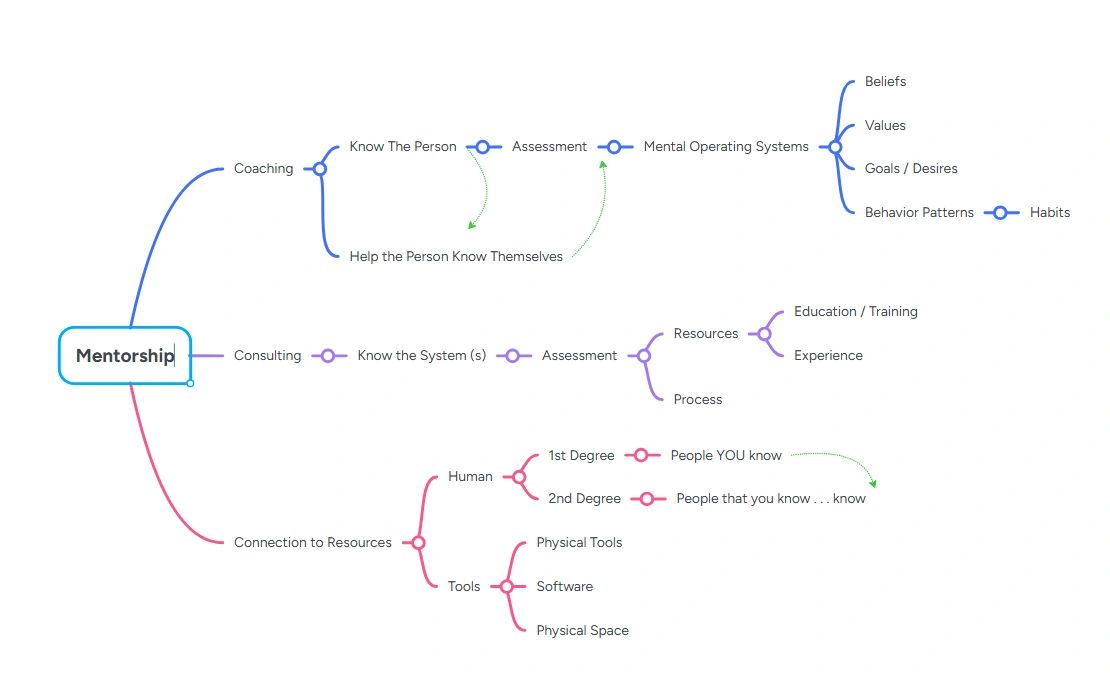
Human connection
First degree: people you know. Direct introductions. High trust, low reach.
Second degree: people that the people you know know. Lower trust per link, dramatically higher reach.
The second degree is where the value concentrates, and this is not intuition. Granovetter (1973) demonstrated that novel information travels through weak ties rather than strong ones, precisely because your close contacts already know what you know. Burt (2004) extended the argument structurally: people positioned across gaps between otherwise disconnected groups, what he called structural holes, have earlier access to more varied information and are measurably more likely to produce ideas judged as valuable. A mentor's most transferable asset is not their wisdom. It is their position in a network the mentee cannot see.
This reframes the whole relationship. Higgins and Kram (2001) made this shift formal, reconceptualizing mentoring away from the single senior figure and toward a developmental network, the constellation of people actively invested in advancing someone's development. Under that model, one of the mentor's central jobs is to make themselves structurally less important by building the mentee's constellation.
There is also a hard-edged distinction here that the connection branch forces into the open. Ibarra, Carter, and Silva (2010) surveyed over 4,000 high potentials and found that more women than men had mentors, and that women were nonetheless advancing less. Their explanation was that mentoring and sponsorship are not the same act. Mentors give feedback and advice. Sponsors spend their own political capital advocating for someone in rooms that person is not in. Their finding was that high-potential women were over-mentored and under-sponsored. If your connecting consists entirely of encouragement, you are doing the pleasant half of the job.
Tool connection
The map's second branch under connection is the one people skip because it sounds trivial. It is not.
Physical tools. The equipment, the instruments, the access.
Software. The platform that turns a six-hour task into a thirty-minute one. In academic mentoring specifically, this often means pointing a junior colleague toward the infrastructure that makes their teaching load survivable. A collaborative annotation platform like Perusall, for instance, changes what is possible with assigned readings, because it makes student preparation visible before class rather than guessable during it. That is a connection a mentor can make in one sentence that saves a mentee two semesters of trial and error.
Physical space. The lab, the desk, the room, the clinic slot. Access to space is access to practice.
Failure mode. Connecting without coaching or consulting is networking. The mentee gets a stack of introductions to people they are not prepared to talk to and cannot evaluate, and burns the mentor's credibility doing it.
Why the Sequence Matters
These three functions are not interchangeable modules. They have a dependency order.
Coaching comes first, because until you understand the mentee's operating system you cannot tell which parts of the system matter to them. Consulting comes second, because the systems analysis has to be aimed at a target the coaching identified. Connection comes last, because introductions are irreversible. You can revise your advice. You cannot un-introduce someone.
The most common mentoring failure I see is a mentor who starts at function three because it is the fastest way to feel helpful, sends a warm introduction, and never learns that the mentee did not want the thing they were introduced to.
A Self-Audit for Mentors
Ask yourself, about a specific person you are currently mentoring:
Coach: Can I name three things this person believes about themselves that are limiting them? Have I ever said any of them out loud to this person? Could they now run this analysis on themselves without me?
Consultant: Do I know how the system they are in currently works, or how it worked when I was in it? When did I last verify that? What is the one process fact they need that nobody has told them?
Connector: How many introductions have I actually made in the last six months, as opposed to offered? Have I ever spent political capital on this person in a room they were not in?
If you answered cleanly across all three, you are unusual. Most of us are strong in one, adequate in another, and quietly absent in the third. The point of the model is not that you must personally supply all three. It is that all three must be supplied, and if you are only providing one, the honest thing is to say so and help build the rest of the constellation.
The perfect mentor may not be a person at all. It may be a network, correctly assembled.
References
Argyris, C., & Schön, D. A. (1974). Theory in practice: Increasing professional effectiveness. San Francisco, CA: Jossey-Bass.
Burt, R. S. (2004). Structural holes and good ideas. American Journal of Sociology, 110(2), 349-399.
Deci, E. L., & Ryan, R. M. (1985). Intrinsic motivation and self-determination in human behavior. New York, NY: Plenum Press.
Eby, L. T., Allen, T. D., Evans, S. C., Ng, T., & DuBois, D. L. (2008). Does mentoring matter? A multidisciplinary meta-analysis comparing mentored and non-mentored individuals. Journal of Vocational Behavior, 72(2), 254-267. doi:10.1016/j.jvb.2007.04.005
Granovetter, M. S. (1973). The strength of weak ties. American Journal of Sociology, 78(6), 1360-1380.
Higgins, M. C., & Kram, K. E. (2001). Reconceptualizing mentoring at work: A developmental network perspective. Academy of Management Review, 26(2), 264-288.
Ibarra, H., Carter, N. M., & Silva, C. (2010). Why men still get more promotions than women. Harvard Business Review, 88(9), 80-85.
Kram, K. E. (1985). Mentoring at work: Developmental relationships in organizational life. Glenview, IL: Scott, Foresman.
Ryan, R. M., & Deci, E. L. (2000). Self-determination theory and the facilitation of intrinsic motivation, social development, and well-being. American Psychologist, 55(1), 68-78.
Schein, E. H. (1999). Process consultation revisited: Building the helping relationship. Reading, MA: Addison-Wesley.
Schein, E. H. (2013). Humble inquiry: The gentle art of asking instead of telling. San Francisco, CA: Berrett-Koehler.
Theeboom, T., Beersma, B., & van Vianen, A. E. M. (2014). Does coaching work? A meta-analysis on the effects of coaching on individual level outcomes in an organizational context. The Journal of Positive Psychology, 9(1), 1-18. doi:10.1080/17439760.2013.837499