
The Science of Caring WellAugust 23, 2026 · 10 min read
Part One: What It Feels Like From the Inside
I noticed it first with the jar of pickles.
Not a fall. Not a hospital stay. A jar of pickles that would not open, no matter how I braced it against the counter or wrapped the lid in a dish towel the way my mother taught me sixty years ago. I set it back in the refrigerator, unopened, and told myself I did not really want pickles anyway.
That is how it happens, in case you are wondering. Not all at once. Independence does not leave through the front door with a suitcase. It slips out through a hundred small exits. The pickle jar. The porch step that suddenly requires the railing. The evening drive I stopped taking because headlights bloom into starbursts now. The bathtub I still use, but only when someone else is in the house, though I have never said that out loud to anyone.
Here is what I want you to understand, because I am not sure my daughter does. Every one of those small surrenders costs me something you cannot see. When you were a child, I carried you up these stairs. I rewired the light fixture in the hallway myself. I drove this family to Georgia and back with no GPS and no complaints. Those things were not just tasks. They were who I was. So when you stand in my kitchen and say, gently, “Mom, maybe you shouldn’t be using the step stool anymore,” you believe you are talking about a step stool. I hear something else entirely. I hear the person I have been my whole life being retired without my consent.
And I want to tell you a secret that shames me a little: I hide things from you. When I stumbled on the back patio in March, I did not mention it. When I burned the bottom of the kettle because I walked away and forgot it, I bought a new kettle before your Sunday visit. I am not hiding these things because I do not trust you. I am hiding them because I know how the story goes. Each thing I admit becomes evidence. Enough evidence, and someone starts talking about what would be “easier” for me, and easier is a word that has started to frighten me, because easier always seems to mean smaller. A smaller house. A smaller life. A smaller me.
I know you lie awake worrying about me falling. I need you to know that I lie awake too, but I am not only afraid of falling. I am afraid of becoming a problem to be managed instead of a person to be known. I am afraid that the first time I need help in the bathroom will be the last time anyone asks my opinion about anything.
So when I snap at you for moving my rug, or refuse the shower chair you bought, please hear what is underneath it. It is not stubbornness for its own sake. It is a person trying to hold on to the last things that are still hers to decide.
Part Two: The View From the Doorway
I have stood in more than a thousand doorways like hers.
I am a home safety professional, a physical therapist. My colleagues in occupational therapy do this work too, and after decades of home visits, I can tell you that the story above is not one story. It is nearly every story. The details change. The pickle jar becomes a pill bottle, the step stool becomes a ladder, the patio stumble becomes a slide down the last two stairs. But the emotional architecture is almost always the same: fear on both sides, love on both sides, and a conversation that keeps failing because everyone is arguing about the wrong thing.
Families call me because they want the house made safe. What they often expect is that I will arrive with a clipboard and a list of prohibitions. Take away the throw rugs. Take away the tub. Take away the stairs, the stove, the car keys. Subtract the dangers until only safety remains.
Here is what I have learned instead, and it is the single most important thing I can teach a caregiver: you cannot subtract your way to safety, because the most dangerous thing in that house is not the rug. It is the loss of the person’s reasons to keep moving, deciding, and caring.
When we strip away too much, people do not become safe. They become sedentary, and sedentary older adults get weaker, and weaker people fall more, not less. They become depressed, and depressed people stop eating well, stop taking medications correctly, stop calling for help when something is wrong. And they become secretive, exactly like the woman in Part One, because they have learned that disclosure leads to loss. A person who hides her stumbles from you is far more at risk than a person who feels safe telling you about them. The relationship itself is a piece of safety equipment, and it is the one most often broken.
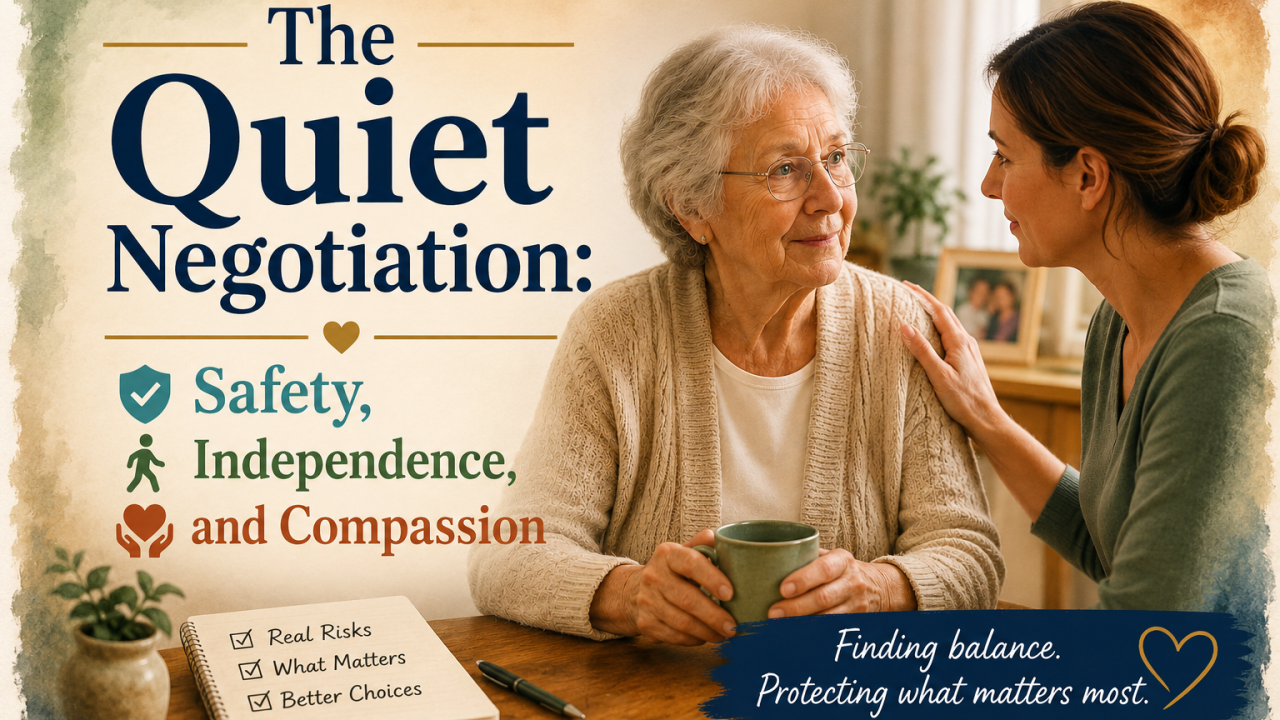
So my job is not to eliminate risk. My job is to manage a negotiation between two things that both matter: the real possibility of injury, and the equally real possibility of a life so restricted it is no longer worth protecting. We do this person by person, task by task, room by room.
Let me show you what that looks like in practice.
The bathtub. The family wants the tub declared off limits. Mom wants her baths; she has ended her day with one since 1974, and it is one of the last pleasures her arthritis has not taken. The wrong answer is a flat no. The right answer is engineering the wish. A properly installed grab bar (anchored into studs, never a suction cup model, which I have seen fail at the worst possible moment), a transfer bench, a handheld shower, a nonslip surface, and three or four practice sessions with me standing by until the movement pattern is smooth and automatic. Now she bathes safely, and just as important, she has learned that telling us what she wants leads to solutions, not confiscations.
The stairs. The son wants his father to move his bedroom to the main floor. Dad refuses; upstairs is where he has slept beside his late wife’s photograph for nine years. Instead of a standoff, we compromise structurally and behaviorally. Solid railings on both sides, high contrast tape on the stair edges because aging eyes lose depth perception at exactly the spot where the last step meets the floor, brighter bulbs on the landing, motion sensor switches. A new rule he helps write: stairs only during daylight hours, and never while carrying laundry. The laundry now goes in a bag that waits for his son. He kept his bedroom. The family got a plan they can live with, for now. Notice who wrote the rule.
The kitchen. The burned kettle is not a reason to unplug the stove. It is a reason to look closer. Is this occasional distraction or a pattern of forgetting? Those are different problems with different answers. For distraction, an inexpensive electric kettle with automatic shutoff and induction cooking that cools quickly may be enough. For genuine memory change, we might shift the riskiest cooking to shared cooking, where she still directs the recipe, still seasons the sauce, still owns the meal, while someone else manages the flame. She remains the cook. The role is preserved even as the task is redistributed. That distinction, role versus task, is one of the most powerful tools a caregiver has.
The rug she will not give up. Sometimes I lose the rug argument, and I have learned to lose it gracefully when the rug is not the true hazard. A firmly secured rug with a proper nonslip pad, edges taped down, in a well lit hallway, is a modest risk. A furious standoff that teaches her to stop listening to anyone’s suggestions is a large one. I spend my credibility where the danger is greatest, and I let some smaller battles go. Caregivers should too.
The falls she hides. This one is for you directly. If you discover a concealed stumble or a bruise with a vague explanation, the instinct is to confront. Resist it. Confrontation confirms her theory that honesty is dangerous. Try instead: “I’m not going to take anything away from you. I just want to understand what happened so we can outsmart it together.” Then keep that promise. The first time a disclosure results in a solution instead of a restriction, the hiding starts to end. And near misses are gold. Every stumble that did not become a fall is free information about exactly where the next fall is coming from.
A few principles tie all of this together.
Ask before you act. The most valuable question in my profession is not “What is dangerous here?” It is “What do you need to be able to keep doing for your life to feel like yours?” Start there, and safety modifications become tools in service of her goals rather than monuments to her decline. The shower chair that was rejected as an insult when it appeared unannounced in the bathroom is often accepted when it is her chosen means of keeping her nightly bath.
Trade, don’t take. Every restriction should come paired with a preservation. If night driving has to end, then the Thursday card game it enabled must be protected some other way, and figuring out that ride is part of the safety plan, not an afterthought. A safety plan that quietly deletes the reasons a person gets up in the morning has failed, whatever the checklist says.
Let her hold the pen. People follow rules they helped write and quietly defy rules imposed on them. Dignity is not the enemy of compliance. It is the mechanism of it.
Accept that some risk remains. This is the hardest one. A competent adult retains the right to make choices you would not make for her. Our goal is informed risk, understood and reduced, not zero risk. Zero risk exists nowhere on earth, and pursuing it inside your mother’s home will cost you the very relationship that keeps her safest.
Part Three: For the One Standing in the Middle
If you are the caregiver, you are carrying the heaviest part of this. You are the one who gets the 2 a.m. worry and the Sunday afternoon argument. You are afraid of the phone call about a fall, and you are also grieving, a little at a time, the parent who once seemed permanent. Both of those feelings are legitimate. Neither one should hold the pen alone.
So here is what I hope you take from both voices in this article. When she refuses the shower chair, she is not rejecting your love; she is defending her personhood with the tools she has left. When you insist on the grab bar, you are not stealing her freedom; you are trying to keep her in her own story longer. You are, in truth, on the same side. You both want her life to remain hers.
Get a professional into the home if you can. A physical or occupational therapist doing a home safety evaluation sees things families cannot, partly because we know where falls actually happen (bathrooms, thresholds, the last step, the middle of the night on the way to the toilet) and partly because we are not carrying fifty years of family history into the conversation. Advice lands differently from a stranger with a license than from a daughter with a worried face. Let us be the ones who say the hard things. Save your voice for the thing only you can say, which is this:
“I am not trying to shrink your life. I am trying to help you keep it. Teach me what matters most to you, and we will protect that first.”
Then listen. The negotiation goes better than you would think, once both sides realize it was never really about the rug.