
The Science of Caring WellJanuary 16, 2026 · 9 min read
.webp)
Abstract: This article challenges the conventional focus on time management, arguing instead that energy management is the key to productivity and fulfillment. Drawing on Csikszentmihalyi's flow theory, Loehr and Schwartz's performance research, and Carol Ryff's six-factor model of psychological well-being, the author presents energy as a systems variable flowing through interconnected subsystems: self-acceptance, positive relations, autonomy, environmental mastery, purpose, and personal growth. Common energy drains (toxic relationships, meaningless tasks, decision fatigue, harsh self-criticism, and stagnation) are reframed as failures within specific wellbeing subsystems that cascade throughout the entire system. The article proposes that flow states require functioning wellbeing architecture, explaining why calendar optimization alone cannot restore depleted capacity for deep engagement. Practical strategies for achieving flow through targeted systems restoration are offered, including creative pursuits, exercise, meaningful social interactions, altruism, and purpose-driven activities. A diagnostic 2x2 matrix tool helps readers identify which activities drain energy versus restore specific wellbeing dimensions, enabling strategic small adjustments that compound across multiple subsystems.
Read Time: 9:00 or Listen on Speechify
"Your World is Perfectly Arranged to Give You The Results You are Currently Getting"— W. Edwards Deming
Energy as a Systems Variable
We constantly strive to maximize our finite and non-renewable resource: time. But what if the real issue preventing fulfillment isn't time management at all? What if we've been optimizing the wrong variable?
Drawing from the work of Mihaly Csikszentmihalyi in Flow: The Psychology of Optimal Experience (1990) and Loehr and Schwartz's research on sustainable performance, we find that managing energy rather than time is the key to optimal productivity and fulfillment. But here's where systems thinking adds a crucial insight: energy isn't just one thing. It flows through multiple interconnected subsystems within our wellbeing architecture.
When viewed through Carol Ryff's six-factor model of psychological well-being, we can see that energy operates across six distinct yet interconnected dimensions: self-acceptance, positive relations with others, autonomy, environmental mastery, purpose in life, and personal growth. Dysfunction in any one of these subsystems creates energy drains that cascade throughout the entire system. This is why someone might have plenty of "free time" yet feel chronically depleted. The time is there, but the energy has been siphoned off by failing subsystems.
Understanding Flow Through a Systems Lens
Csikszentmihalyi's flow theory describes a state of deep concentration and engagement that occurs when a person becomes completely absorbed in an activity, losing track of time and external pressures. To enter this flow state, one must have clear goals, and the task must be both challenging and engaging. The rewards include a sense of accomplishment, enhanced productivity, and intrinsic joy derived from the task itself.
But flow doesn't emerge in isolation. It requires a functioning wellbeing system. When your autonomy is compromised, you cannot choose tasks aligned with your strengths. When environmental mastery falters, external chaos disrupts concentration. When purpose erodes, even challenging tasks feel meaningless. Flow, then, is not just about finding the right activity. It's about having enough functioning subsystems to support the state.
This is why simply "making time" for meaningful work rarely solves the problem. If your wellbeing system is in dysfunction, no amount of calendar optimization will restore your capacity for deep engagement.
The Problem with Time Management
Traditional time management assumes that organizing and scheduling efficiently leads to productivity and fulfillment. But as Loehr and Schwartz (2003) demonstrated, sustainable productivity requires managing energy, not just time. This means renewing and replenishing our energy by engaging in activities that inspire, challenge, and satisfy us across multiple dimensions of wellbeing.
Many of us have more time than we realize. The problem is that we expend our energy on tasks and interactions that drain us, leaving little for activities that contribute to flourishing. We end up on the couch at day's end, capable of little more than scrolling through our phones or watching fictional people do made-up things. This isn't laziness or poor discipline. It's a predictable output of a well-being system operating in a state of dysfunction.
Energy Drains as Systems Failures
When we examine common energy drains through a systems lens, we can identify which wellbeing subsystems are under strain:
Toxic Relationships (Positive Relations subsystem): Interactions with people who are negative, unsupportive, or manipulative deplete emotional energy and undermine the social connection that buffers us against psychological distress.
Meaningless Tasks (Purpose subsystem): Repetitive or mundane tasks that lack purpose sap mental and physical energy. Without a sense of direction or significance, such tasks prevent flow states and erode our sense that life holds meaning beyond immediate circumstances.
Decision Fatigue (Autonomy and Environmental Mastery subsystems): Being overwhelmed by too many decisions in a short period drains regulatory resources, making it harder to evaluate choices by personal standards or manage environmental complexity effectively (Vohs et al., 2008).
Harsh Self-Criticism (Self-Acceptance subsystem): When we hold negative attitudes toward ourselves and ruminate on past failures, we deplete the internal foundation upon which psychological security is built.
Stagnation (Personal Growth subsystem): When learning opportunities disappear or work environments offer no pathway for development, the sense of continued expansion essential for well-being erodes.
Notice how these drains don't just steal time. They attack specific subsystems within the wellbeing architecture, and dysfunction in one area cascades throughout the whole. A professional who loses autonomy may begin to question their purpose. Someone experiencing fractured relationships may lose the social support necessary for self-acceptance. Environmental chaos undermines the mastery required for personal growth.
Can you identify which subsystems are most under strain in your own life?
Achieving Flow Through Systems Restoration
To achieve fulfillment, we must not only protect our energy but channel it into activities that restore functioning across multiple wellbeing dimensions. Csikszentmihalyi's flow activities do precisely this: they challenge our skills, offer clear goals, and engage us deeply. But we can be even more strategic by selecting activities that restore specific subsystems.
Creative Pursuits (Personal Growth + Purpose): Engaging in activities like painting, writing, or problem-solving challenges both mind and spirit, maintaining the sense of growth and realizing potential that sustains wellbeing.
Exercise and Physical Activity (Environmental Mastery + Self-Acceptance): Physical movement releases endorphins and builds a sense of competence while cultivating positive feelings about one's body.
Meaningful Social Interactions (Positive Relations): Time spent with positive, supportive people boosts emotional energy and strengthens the relational subsystem that buffers against distress (Fredrickson & Joiner, 2002).
Activities of Altruism (Purpose + Positive Relations): Helping others without expecting anything in return connects us to purpose larger than ourselves while strengthening our capacity for empathy and intimacy. When we help others, our focus shifts away from self-centered concerns, reducing stress and increasing the likelihood of entering flow (Post, 2005).
Purpose-Driven Activities (Purpose + Autonomy): Individuals who engage in activities connected to their larger life purpose experience higher psychological well-being and are more likely to enter flow states (Steger, Kashdan, & Oishi, 2008). When actions align with personal standards and values, attention becomes fully absorbed and distractions diminish.
The key is ensuring that your energy flows toward activities that don't just challenge and engage you, but that restore functioning in subsystems that have become depleted.
Time Is Not the Problem. The System Is.
Managing time alone will not lead to a fulfilling life if your well-being system operates in dysfunction. The energy drains you experience are not random misfortunes or personal failures. They are predictable outputs of a system producing its logical results.
As Deming taught us, if we want different results, we must change the system. By managing your energy and directing it toward activities that restore functioning across multiple wellbeing dimensions, you can create leverage for meaningful change. You don't need to understand or transform the entire system at once. Stack several small adjustments across multiple subsystems, and the effects multiply.
Try This: A Systems Diagnostic
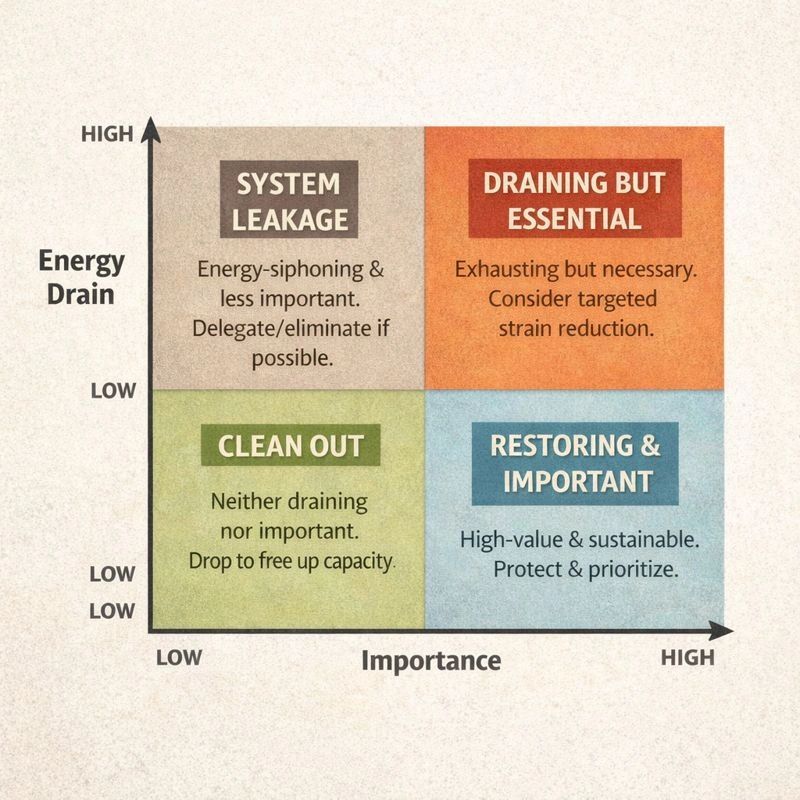
Using a simple 2x2 matrix, plot your activities based on energy drain versus importance. But this time, add a systems layer by noting which wellbeing dimension each activity most affects.
X-axis: Importance (Low to High) Y-axis: Energy Drain (Low to High)
Quadrants:
High Energy Drain, High Importance (Top-Right): These tasks are both draining and essential. Identify which wellbeing subsystem they strain, then consider whether targeted restoration of that subsystem might reduce the drain.
Low Energy Drain, High Importance (Bottom-Right): These tasks are important and manageable. Notice which subsystems they may be restoring, and prioritize these activities.
High Energy Drain, Low Importance (Top-Left): These tasks are energy-siphoning and less important. Delegate or eliminate them whenever possible. They represent system leakage.
Low Energy Drain, Low Importance (Bottom-Left): These tasks neither drain much energy nor add importance. Consider dropping them to free up capacity for restoration.
Reflection Prompts:
- In what quadrant do most of your activities lie?
- What are your "flow" experiences, and which well-being dimensions do they restore?
- Which subsystems (self-acceptance, positive relations, autonomy, environmental mastery, purpose, personal growth) are most depleted?
- Are the most energy-draining tasks straining the same subsystem repeatedly? If so, can you approach them differently or restore that subsystem through other means?
- What 2-3 concrete actions could shift your wellbeing system toward different results?
Your world is perfectly arranged to give you the results you are currently getting. If depletion is the result, the system must change, one subsystem at a time.
References
Csikszentmihalyi, M. (1990). Flow: The psychology of optimal experience. Harper & Row.
Deming, W. E. (1993). The new economics for industry, government, education. MIT Press.
Fredrickson, B. L., & Joiner, T. (2002). Positive emotions trigger upward spirals toward emotional well-being. Psychological Science, 13(2), 172-175.
Loehr, J., & Schwartz, T. (2003). The power of full engagement: Managing energy, not time, is the key to high performance and personal renewal. Free Press.
Post, S. G. (2005). Altruism, happiness, and health: It's good to be good. International Journal of Behavioral Medicine, 12(2), 66-77.
Ryff, C. D. (1989). Happiness is everything, or is it? Explorations on the meaning of psychological well-being. Journal of Personality and Social Psychology, 57(6), 1069-1081.
Steger, M. F., Kashdan, T. B., & Oishi, S. (2008). Being good by doing good: Daily eudaimonic activity and well-being. Journal of Research in Personality, 42(1), 22-42.
Vohs, K. D., Baumeister, R. F., & Schmeichel, B. J. (2008). Decision fatigue exhausts self-regulatory resources. Journal of Personality and Social Psychology, 94(5), 883-898.