
January 12, 2026 · 7 min read
Every healthcare innovation founder faces the same impossible arithmetic: infinite tasks, finite time. The difference between companies that survive and those that exhaust their resources before reaching product-market fit often comes down to a single discipline: the ruthless prioritization of what actually matters.
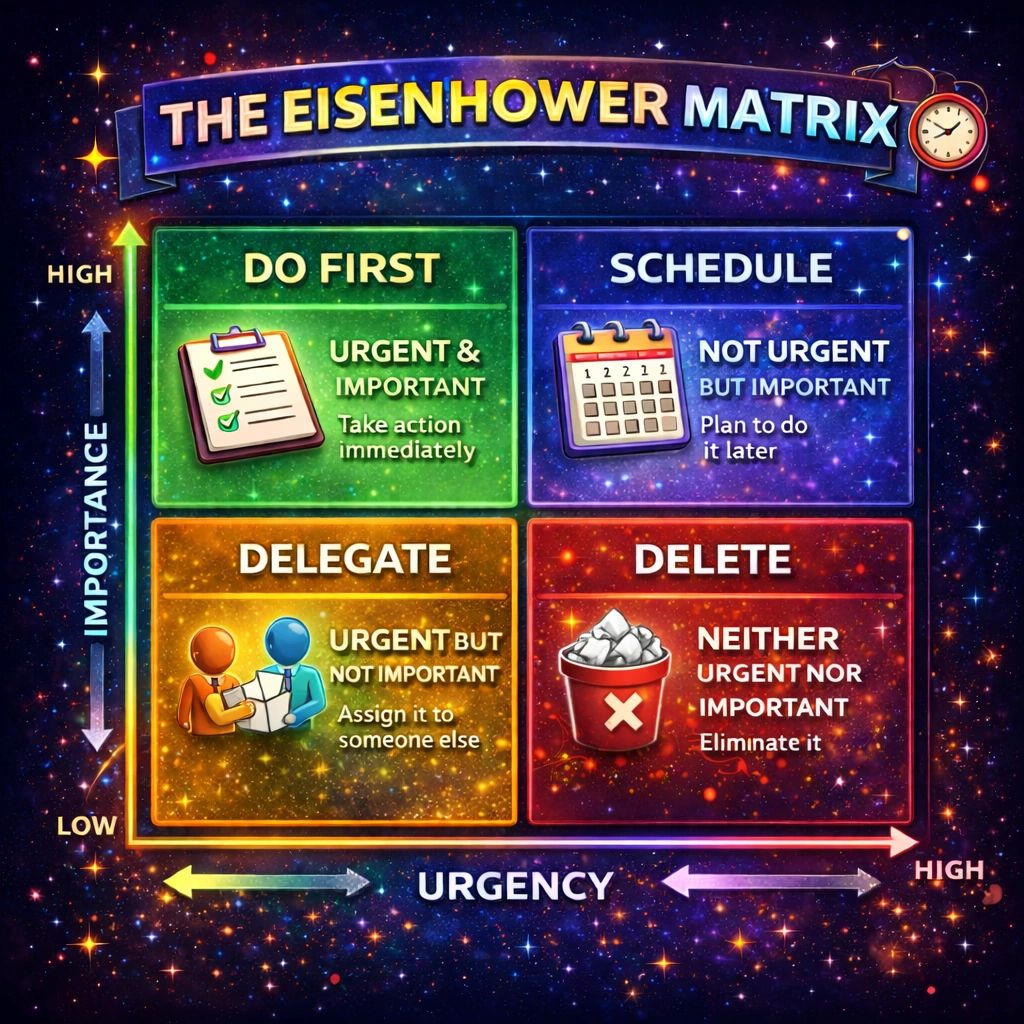
The Eisenhower Matrix offers a deceptively simple framework for this discipline. But in healthcare, where the stakes include patient outcomes, regulatory consequences, and the complex dance of reimbursement, applying this framework requires a deeper understanding than most productivity guides provide.
The Healthcare Innovation Paradox
Here is the paradox that traps most health-tech founders: the tasks that feel most urgent are rarely the ones that determine success. Building features, responding to investor inquiries, and chasing partnership meetings all generate dopamine hits of productivity. Meanwhile, the questions that actually matter: who is paying and how much will they pay, sit in the Not Urgent quadrant, quietly determining your fate.
As I explored in The Formula for Success, the equation for organizational success multiplies the quality of strategic questions by the frequency of asking them, raised to the power of integrity in answering. The Eisenhower Matrix is simply a tool for ensuring you ask the right questions frequently enough, and have the integrity to act on answers you may not want to hear.
How Exceptional Leaders Use the Matrix Differently
Here is what separates exceptional leaders from merely competent managers: they structure their affairs so they can concentrate on Quadrant II, the Important but Not Urgent work that determines long-term success. They do not achieve this by ignoring urgent matters. They achieve it by planning so well that few things become urgent in the first place.
This insight comes directly from leadership science. Stephen Covey's research on highly effective people identified Quadrant II focus as the defining characteristic of proactive leadership. Peter Drucker's studies of executive effectiveness found that the best leaders spend disproportionate time on activities that prevent crises rather than responding to them. And contemporary research on cognitive load confirms why: reactive work depletes the mental resources required for strategic thinking.
For healthcare innovation founders, this means building systems that handle predictable challenges before they become fires. The reimbursement question you answer proactively in month three does not become the crisis that derails your Series A in month eighteen.
Quadrant I: Urgent and Important
These are your legitimate fires: the FDA warning letter, the security breach, the key clinical champion who is about to leave. In healthcare innovation, Quadrant I tasks often involve patient safety, regulatory compliance, or existential threats to your business model.
The trap: Many founders manufacture Quadrant I crises through poor planning. When you have not done the reimbursement analysis (Quadrant II), you discover at the eleventh hour that your product has no pathway to payment. That is not an external crisis. That is a self-inflicted wound now requiring emergency triage.
The discipline: Audit your Quadrant I tasks monthly. Ask honestly: How many of these crises resulted from neglecting Quadrant II work? The answer reveals whether you are leading your company or merely reacting to it.
Quadrant II: Important but Not Urgent
This is where health-tech companies are won or lost. Quadrant II contains the strategic work that determines whether your innovation survives first contact with the healthcare system.
For healthcare innovation founders, Quadrant II work includes understanding CPT codes and billing workflows before you finalize product design, mapping the four-dimensional friction problem (patient, clinical, institutional, and economic adoption barriers), building relationships with potential reimbursement champions, developing regulatory strategy aligned with your commercial pathway, and creating the evidence base payers will require. None of these tasks will feel urgent until they become crises. By then, you have lost months or years of runway.
The discipline: Block time for Quadrant II work as aggressively as you protect investor meetings. Schedule reimbursement strategy sessions. Put payer landscape analysis on the product roadmap. The founder who treats Quadrant II as optional is betting their company on luck.
Practical Tools from Leadership Science
Leadership research offers concrete tools for maintaining Quadrant II focus.
Weekly strategic reviews. Drucker recommended that executives conduct weekly reviews asking: What did I accomplish that moved the organization toward its most important goals? Cal Newport's research on deep work suggests blocking the first hours of each day for Quadrant II thinking before reactive work can intrude.
Anticipatory planning. The practice of identifying what could become urgent and addressing it now. In healthcare innovation, this means mapping your regulatory pathway before you need FDA clearance, understanding payer requirements before you need contracts, and building clinical evidence before you need to demonstrate value.
Decision frameworks. Daniel Kahneman's work on cognitive biases shows that reactive decisions are more prone to error. Creating decision frameworks in advance, when you have cognitive bandwidth, improves the quality of choices made under pressure. For healthcare founders, this means establishing criteria for partnership opportunities, pilot programs, and feature requests before they arrive.
Delegation architecture. John Maxwell's leadership research emphasizes that exceptional leaders build teams capable of handling Quadrant I and III tasks, freeing leadership attention for Quadrant II strategy. This requires investing in team development, another Quadrant II activity that pays compounding returns.
Quadrant III: Urgent but Not Important
This quadrant is the graveyard of healthcare innovation companies. It is filled with activities that feel important because they demand immediate attention: the conference invitation, the partnership inquiry that leads nowhere, the feature request from a prospect who will never become a customer, the meeting about the meeting.
Healthcare makes Quadrant III particularly seductive. The industry runs on relationships, and every connection might lead to that breakthrough partnership or pilot program. But most do not. The energy spent chasing possibilities without strategic filters is energy diverted from the Quadrant II work that actually creates sustainable businesses.
The discipline: Develop filters before opportunities arrive. What is your reimbursement strategy? Which health systems fit that strategy? What evidence will those systems require? Opportunities that do not align with these answers are Quadrant III distractions, regardless of how excited your team gets about them.
Quadrant IV: Neither Urgent nor Important
The easy quadrant to identify, the hard one to eliminate. These are the activities that offer escape from the difficulty of strategic thinking: the endless refinement of pitch decks, the obsessive competitor monitoring, the industry news rabbit holes that feel like research but produce no actionable insights.
In healthcare innovation, Quadrant IV often masquerades as Quadrant II. Reading about regulatory changes feels strategic but rarely is. Attending conferences for networking feels relationship-building but often produces nothing.
The test is simple: does this activity directly advance your understanding of who is paying and how much they will pay? If not, question its presence in your calendar.
Building a Quadrant II Organization
The ultimate goal is not personal Quadrant II focus but organizational Quadrant II focus. Jim Collins' research on great companies found that sustained excellence comes from institutionalizing strategic discipline, not from heroic individual effort.
For healthcare innovation companies, this means embedding the hard questions into organizational rhythms. Monthly reviews that assess reimbursement pathway progress. Quarterly planning that maps adoption barriers. Annual strategy sessions that honestly evaluate product-market fit against payment realities.
When these practices become organizational habits rather than founder heroics, the company develops resilience. The strategic work continues even when the founder is pulled into an inevitable Quadrant I crisis.
The Integrity Test
The Eisenhower Matrix is only as valuable as your integrity in applying it. The framework exposes uncomfortable truths: that urgent does not mean important, that busy does not mean strategic, that activity does not mean progress.
Healthcare innovation demands that you face these truths with unusual clarity. The industry's complexity, regulatory burden, and reimbursement maze create endless opportunities to confuse motion with progress. The matrix cuts through that confusion, but only if you have the courage to use it honestly.
The question is not whether you understand the framework. The question is whether you will structure your leadership so that Quadrant II receives the attention it deserves, not through willpower, but through systems that make strategic focus the default rather than the exception.
Related Reading: The Formula for Success explores the equation that determines whether health-tech companies thrive or merely survive.