January 12, 2026 · 16 min read
The Innovator's Lament
In 1989, I was working on my Master's thesis studying postural changes in people with Parkinson's disease. I had a problem: I needed to quantify those changes reliably. Digital photography did not exist. So I installed a transparent grid at the filmplane of my Nikon FM2 camera, creating standardized measurements on each photograph. Later, I adapted it for a Polaroid camera. It worked beautifully.
In 1996, I was running a rehabilitation department in a nursing home, overseeing a restorative nursing program where staff walked residents according to prescribed instructions. I wanted to understand how these residents were actually performing. So I hacked a bicycle speedometer, recalibrated it for a walker wheel, and reliably captured gait distance, speed, and accumulated distance. Long before health metrics became a billion-dollar industry.
In 2002, after losing 200 pounds, I became a wellness coach, sought training as a chef, and started a physical therapy and coaching practice with a full demonstration kitchen, private coaching rooms, a yoga space, and a classroom where we held workshops on helping people make sustainable lifestyle changes. The term "lifestyle medicine" had not yet been coined. This practice later evolved into an online coaching program and a meal kit company emphasizing easy-to-prepare whole-food plant-based meals.
In 2004, I started working on an app that read data from a heart rate sensor attached to a user's chest and linked to their playlist. The app would choose the music and subtly change the tempo based on heart rate data, allowing users to receive subtle cues to step up their workouts and keep their heart rate in a pre-prescribed range. For less subtle cues, the playlist would include recorded "coaching moments" to inspire the user to higher performance. This was years before the Apple Watch, before Spotify's running features, before any mainstream integration of biometric data with music.
Every one of these innovations had things in common. They all started with a problem I needed to solve. They all worked spectacularly well. They were all years ahead of their time. I was passionate about the potential of each idea. And I was woefully ill-equipped to scale or capitalize on any of them. They all struggled commercially to achieve the success I believed them to warrant.
This is not a story about bad luck or poor execution. It is a story about how innovation actually works, and Thomas Kuhn's The Structure of Scientific Revolutions explains why.
The Real Meaning of "Paradigm Shift"
Few academic terms have been so thoroughly diluted as "paradigm shift." Today, every new app claims to be a paradigm shift. Every incremental feature update gets marketed as paradigm-shifting. The phrase has become meaningless through misuse and overuse.
Kuhn meant something far more specific and far more powerful.
A paradigm, in Kuhn's original formulation, is not merely a theory or a technology. It is the entire constellation of beliefs, values, techniques, and shared examples that define a scientific community at a particular moment in time. It's not YOUR world view. It's the predominant view of the world you are living in.
The paradigm tells practitioners of science what questions are worth asking, what counts as an acceptable answer, what tools and methods are legitimate, and what problems can be safely ignored.
Normal science operates within this framework. Scientists are not, as the popular image suggests, constantly seeking revolutionary insights. They are puzzle-solvers working on problems that the paradigm itself defines, using methods the paradigm approves, expecting results the paradigm would recognize as valid. Kuhn compared this work to jigsaw puzzles, where the goal is not to create something new but to fit pieces into a predetermined pattern.
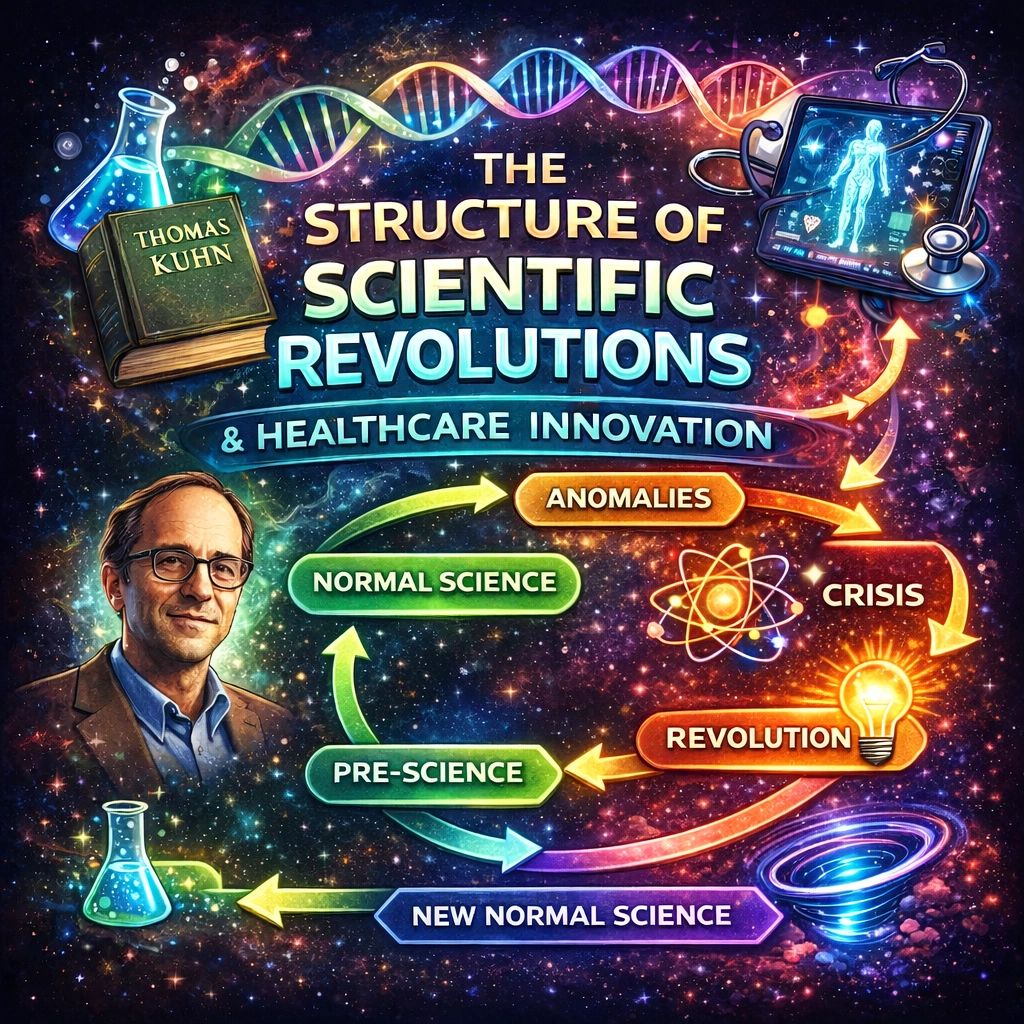
A genuine paradigm shift occurs only when accumulated anomalies, problems that cannot be solved within the existing framework, create what Kuhn called a crisis. The old paradigm does not gently give way to the new. It resists. Practitioners have invested careers in mastering its methods. Institutions have been built around its assumptions. Reputations depend on its continued relevance.
And here is the critical insight for innovators: a paradigm shift cannot occur simply because someone has a better idea. The community must be ready to receive it. The crisis must be widely felt. The alternative must be comprehensible within the conceptual vocabulary available to practitioners.
Anomalies and the Prepared Mind
Kuhn documented something counterintuitive about discovery. Anomalies, those observations that do not fit the expected pattern, are not immediately recognized as important. Priestley isolated oxygen in 1774 but did not understand what he had found. He called it "dephlogisticated air" and interpreted it through the lens of the old phlogiston theory. Lavoisier, working within a different framework and primed by earlier suspicions that something was wrong with phlogiston theory, saw the same experimental results and recognized a new element.
The same data. Two different conclusions. The difference was not intelligence or luck. It was preparation, specifically preparation that came from an existing sense that the old paradigm was failing.
Kuhn wrote that "the man who is striving to solve a problem defined by existing knowledge and technique is not just looking around. He knows what he wants to achieve, and he designs his instruments and directs his thoughts accordingly." This is precisely why breakthrough innovations often go unrecognized. They solve problems that the existing paradigm does not yet acknowledge as problems.
Consider my postural measurement system. In 1989, rigorous quantification of postural changes in rehabilitation settings was not a recognized need within physical therapy's standard practice. The paradigm focused on qualitative assessment, clinical judgment, and functional outcomes defined by existing measures. A gridded camera system was a solution to a problem that most practitioners did not know they had.
My hacked walker speedometer faced the same challenge. Restorative nursing programs focused on compliance, whether prescribed walking happened at all, and performance metrics like speed and accumulated distance were simply not seen as key measures. Generally, a guesstimate was good enough. The data this device produced did not fit into existing quality measures or reimbursement frameworks.
My lifestyle medicine practice preceded both the terminology and the institutional recognition of integrated wellness approaches in healthcare. It was a working model for something the healthcare system was not yet structured to value, pay for, or even conceptualize as legitimate medicine.
The Timing Problem in Healthcare Innovation
Healthcare presents a particularly difficult version of the timing problem because it operates under multiple overlapping paradigms simultaneously.
There is the clinical paradigm, which defines what constitutes valid evidence, proper treatment protocols, and professional competence. There is the regulatory paradigm, which determines what is safe enough to permit and what requires approval. There is the reimbursement paradigm, which controls what services can be paid for and at what rates. And there is the institutional paradigm, which governs how hospitals, practices, and health systems actually operate day to day.
An innovation in healthcare technology must achieve acceptance across all of these domains to succeed commercially. Clinical efficacy is necessary but not sufficient. A brilliant solution that improves outcomes but does not have a CPT code, does not fit existing workflows, and cannot be reimbursed, will struggle regardless of how well it works.
This is why the question "who is paying and how much will they pay" must precede questions about clinical validation or user experience. It is not because money matters more than health outcomes. It is because reimbursement complexity is itself a paradigm, with its own internal logic, its own community of practitioners, and its own resistance to change.
Kuhn observed that before a paradigm shift can occur, practitioners must feel that existing approaches are failing. They must experience what he called "pronounced professional insecurity." The proliferation of competing explanations and ad hoc modifications to existing theory is, he noted, "a very usual symptom of crisis."
Look at healthcare today. You will find exactly this pattern: mounting frustration with care coordination failures, rising costs despite massive investment, outcomes that lag behind those of other developed nations, clinician burnout reaching epidemic levels, and an ever-proliferating array of point solutions that never seem to integrate into coherent systems.
The crisis conditions Kuhn described are present. But that does not mean the shift has arrived.
Change by Attrition: The Uncomfortable Truth About How Paradigms Actually Shift
Here is where Kuhn delivers his most sobering insight for innovators. Paradigm shifts do not typically occur because the defenders of the old paradigm are persuaded by superior arguments. They occur because the defenders eventually die or retire.
Kuhn quoted Max Planck's famous observation from his Scientific Autobiography: "A new scientific truth does not triumph by convincing its opponents and making them see the light, but rather because its opponents eventually die, and a new generation grows up that is familiar with it."
Darwin made essentially the same observation at the end of Origin of Species: "Although I am fully convinced of the truth of the views given in this volume, I by no means expect to convince experienced naturalists whose minds are stocked with a multitude of facts all viewed, during a long course of years, from a point of view directly opposite to mine. But I look with confidence to the future, to young and rising naturalists, who will be able to view both sides of the question with impartiality."
Kuhn documented this pattern repeatedly. Copernicanism made few converts for almost a century after Copernicus's death. Newton's work was not generally accepted, particularly on the Continent, for more than half a century after the Principia appeared. Priestley never accepted the oxygen theory. Lord Kelvin never accepted electromagnetic theory.
This is not because these were stupid or stubborn people. Kuhn argued that lifelong resistance from those whose productive careers have committed them to an older paradigm "is not a violation of scientific standards but an index to the nature of scientific research itself." The practitioners who resist have invested everything in mastering the existing paradigm. Their expertise, their reputation, and their very identity as professionals depend on it.
The transfer of allegiance from one paradigm to another is, Kuhn wrote, "a conversion experience that cannot be forced." You cannot argue someone out of a worldview they have spent a career building their life around.
For healthcare innovators, this has profound implications. Even if your innovation is demonstrably superior, even if it solves real problems that the current system cannot solve, you may be waiting not for a decision but for a demographic transition. The question is not just whether your innovation is ready, but whether the field's leadership has turned over sufficiently to receive it.
The Unrewarded Pioneer
If paradigm shifts occur by generational turnover rather than persuasion, a painful corollary follows: the innovators who see the future first frequently do not live to benefit from it. Or if they do live long enough, they have often exhausted their resources, their credibility, or their capacity to capitalize on the very changes they helped bring about.
The early innovator plants seeds in soil that is not yet ready for them. By the time the conditions are right, by the time the crisis has deepened sufficiently, by the time the old guard has retired and a new generation has come of age, the innovator may be too old, too depleted, or simply too far removed from the centers of influence to claim the harvest.
This is not a failure of strategy. It is the structure of paradigmatic change itself.
Consider the mathematics of it. If a paradigm shift requires a generational turnover, we are talking about twenty to thirty years minimum. The person who builds a working prototype at age thirty-five may be sixty-five before the market is truly ready. The company they founded in their forties may have failed twice before the third attempt by someone else succeeds in their seventies.
Scientific textbooks, Kuhn observed, make this pattern invisible. They reconstruct history as if progress were cumulative, as if the current paradigm emerged naturally from everything that came before. The messiness, the failed approaches, the innovations that arrived too soon, all are smoothed over in the retrospective telling.
"The depreciation of historical fact is deeply, and probably functionally, ingrained in the ideology of the scientific profession," Kuhn wrote. "Textbooks thus begin by truncating the scientist's sense of his discipline's history and then proceed to supply a substitute for what they have eliminated."
When movement-based predictiveanalytics become standard practice, the history will not include the clinician who hacked a bicycle speedometer in 1996. When lifestyle medicine achieves full integration with primary care, the history will not include the practice that built a demonstration kitchen years before the field had a name. The contributions are real. The recognition rarely comes.
This is not bitterness. It is simply the honest accounting of how change works. Understanding it matters because it affects how we should think about the work of innovation itself.
Why "Before Its Time" Is Structurally Necessary
Here is the uncomfortable truth that Kuhn's framework reveals: someone must be ahead of their time for paradigm shifts to occur at all. The innovator who sees the problem before the field acknowledges it, who builds the solution before the infrastructure exists to support it, who creates the prototype that will later inspire the scaled version, that innovator is not making a mistake. They are playing an essential role in the larger pattern of change.
Kuhn described how awareness of anomaly, even when not fully developed or explicitly recognized, prepares the way for paradigm change. "What intervened between the first sense of trouble and the recognition of an available alternate must have been largely unconscious," he wrote of some discoveries. The early innovators are part of that largely unconscious preparation.
Consider Thomas Young and the wave theory of light. He published his first accounts at a very early stage of developing crisis in optics, so early that the crisis was "almost unnoticeable" at the time. Yet within a decade, without Young's direct assistance, the problems he had identified "had grown to an international scientific scandal."
My gridded camera system, my walker speedometer, my integrated wellness practice, my music-coaching app, these were not failures of vision. They were contributions to a developing crisis that had not yet reached the tipping point.
This does not make the commercial struggle easier. It does not compensate for the financial and emotional costs of building something the market is not ready to embrace. But it reframes the experience. Being ahead of your time is not a flaw in your strategy. It is evidence that you are seeing something real.
What Tech Leaders Can Learn
If Kuhn's analysis is correct, several implications follow for those building health technology today.
First, understand which paradigm your innovation threatens. If it is primarily a clinical paradigm, you need clinical champions who feel the current approach is failing. If it is a reimbursement paradigm, you need payers who recognize that their current models are not working. If it is an operational paradigm, you need health system leaders frustrated enough with existing workflows to try something new.
Second, look for crisis conditions. Kuhn documented that paradigm shifts require "a growing sense that an existing paradigm has ceased to function adequately." Where in healthcare is that sense of failure most acute? Those are your entry points.
Third, recognize that resistance to your innovation is not irrational. Practitioners have invested in mastering existing approaches. Their expertise, their professional identity, their institutional position all depend on the current paradigm. Kuhn showed that even brilliant scientists resisted paradigm shifts that ultimately proved correct. Joseph Priestley never accepted Lavoisier's oxygen theory, though he had isolated the gas himself. This was not stupidity. It was the normal psychology of paradigmatic commitment.
Fourth, build for translation. The gap between innovation and adoption is not merely a matter of better marketing. It requires conceptual translation so practitioners can understand how the new approach connects to what they already know. Kuhn showed that new paradigms are never adopted by pure logical argument. They must be demonstrated through worked examples that show practitioners what their field would look like under the new framework.
Fifth, measure timing as carefully as you measure product-market fit. A solution that arrives during normal science, when the paradigm is functioning adequately and practitioners feel no pronounced professional insecurity, will face resistance that seems irrational but is structurally inevitable. The same solution arriving during a crisis may find practitioners actively seeking alternatives.
Sixth, be honest about the generational timeline. If your innovation truly threatens an existing paradigm, full adoption may require not just market development but demographic turnover. Plan accordingly. Build sustainable models. And consider whether there are ways to work within existing paradigms while preparing for the shift, rather than demanding immediate revolution.
The Questions That Matter
If there is a single takeaway from applying Kuhn's framework to healthcare innovation, it is this: the quality of your questions matters more than the elegance of your solutions.
Asking "is this clinically effective?" is important but insufficient. The harder questions are: Is the existing paradigm experiencing crisis? Do practitioners feel professional insecurity about current approaches? Is there a conceptual framework that allows decision-makers to understand what this innovation represents? Is the reimbursement system structured to recognize this as legitimate and valuable? Who will pay, how much, and through what mechanism? And critically: What paradigm are the people who would need to approve this operating within, and how many years until they retire?
The answers to these questions determine whether your innovation arrives during normal science or during revolutionary conditions. And that timing, more than the quality of the innovation itself, often determines commercial success.
As for technology, we are in the midst of a generational shift. People fall into roughly three categories regarding technology. Digital natives have never lived in a world without the internet and smartphones. Digital adaptives, like me, grew up without these technologies but evolved with them and became proficient. Digital-averse individuals avoid engaging with technology at all costs.
The digital adaptives are retiring. The digital-averse are even older. We are entering a world where digital natives will be running the show. This is not a minor demographic adjustment. This is, in Kuhn's terms, a revolution. The conceptual framework through which an entire generation understands healthcare delivery, data, communication, and workflow is fundamentally different from the framework that preceded it. The resistance that health-tech innovators faced for decades was not merely institutional inertia. It was paradigmatic incompatibility with decision-makers who literally could not see technology the way the innovators saw it.
That is changing now. Not because the old guard was persuaded, but because they are leaving.
Thomas Kuhn did not write about healthcare technology. He was analyzing how scientific knowledge changes over time. But the structure he identified, the alternation between normal and revolutionary periods, the role of anomaly in preparing for change, the way new paradigms must wait for generational turnover rather than winning arguments, these patterns appear wherever complex systems of knowledge and practice exist.
Healthcare is such a system. Understanding its paradigmatic structure will not guarantee success. But ignoring that structure virtually guarantees that brilliant innovations will remain, as they say, ahead of their time.
And sometimes, perhaps, understanding the structure can help us make peace with the fact that being right and being rewarded are two very different things, on two very different timelines. The innovator's lament is real. But so is the innovator's contribution, whether or not the history books remember to record it.