
Book ClubJanuary 29, 2026 · 4 min read
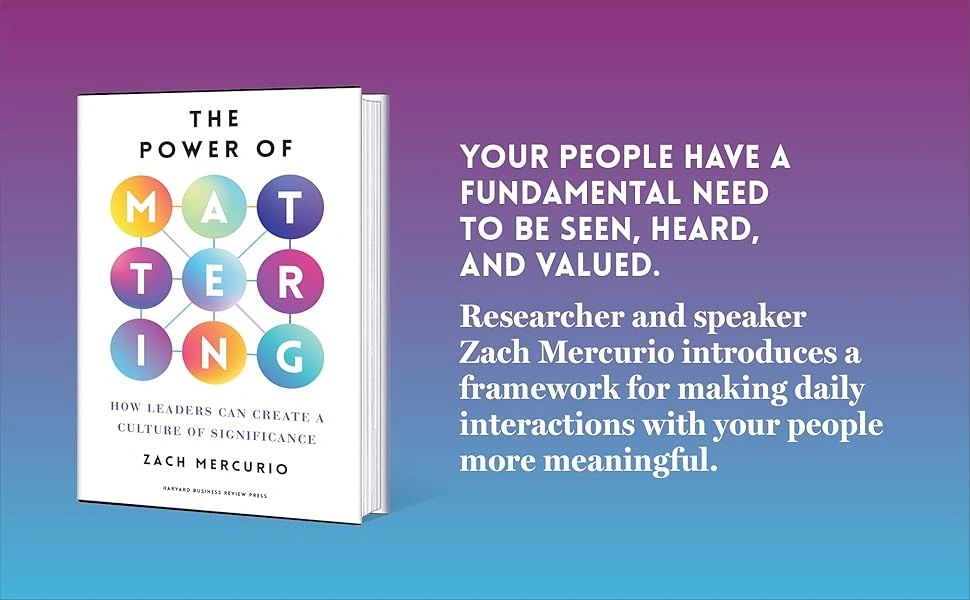
By Zach Mercurio (Harvard Business Review Press, 2025)
Executive Summary
In The Power of Mattering, researcher and speaker Zach Mercurio presents a compelling case that the hidden epidemic of insignificance is fueling workplace mental health crises, intensifying loneliness, and driving disengagement and turnover. Drawing from neuroscience, psychology, and hands-on work with hundreds of organizations, Mercurio reveals that mattering to others is a fundamental, yet often overlooked, requirement for thriving.
The book introduces the NAN Framework, identifying three core dimensions of mattering:
Noticed: The practice of seeing and hearing others with genuine presence and attentiveness
Affirmed: The practice of showing people how their unique strengths make a unique difference
Needed: The practice of showing people they are relied on, indispensable, and essential
Mercurio distinguishes mattering from related concepts like belonging or self-esteem. Mattering is not simply being included; it is being essential. As he writes, mattering is actionable. It is not a vague feeling but a measurable, relational experience that leaders can intentionally cultivate through daily micro-practices.
The book provides more than 25 practical skills, assessments, and exercises, making it immediately applicable for leaders seeking to transform their teams and organizational cultures.
How This Book Maps to Improving Well-being and Reducing Occupational Distress Syndrome
Rating: 5/5
Mercurio's work provides a powerful explanation for how occupational distress develops and, more importantly, what leaders can do to prevent it. The connection to well-being is direct and evidence-based.
Research demonstrates that even minute variations in mattering are stronger predictors of physical and mental health than social support. Gordon Flett's research shows that anti-mattering (experiences of being made to feel invisible, treated as insignificant, having one's thoughts dismissed) creates what he calls "double jeopardy" when combined with loneliness. This pattern is precisely what healthcare professionals experience when organizational practices fail to notice, affirm, and need them.
The cascade toward occupational distress follows a predictable pattern: mattering deficits lead to deterioration of positive relations and erosion of purpose. Compensatory efforts begin as employees increase work hours and self-sacrifice attempting to be noticed and needed, depleting their resources. Eventually, protective withdrawal emerges as depersonalization and cynicism become defenses against the pain of not mattering.
What makes this book particularly valuable is how Mercurio's NAN model maps directly onto Carol Ryff's six dimensions of psychological well-being:
Being NOTICED supports positive relations and self-acceptance because feeling seen validates one's existence and worth.
Being AFFIRMED enhances purpose in life and personal growth by connecting daily work to meaningful contribution.
Being NEEDED reinforces environmental mastery and autonomy through genuine reliance rather than manipulation.
For healthcare professionals facing occupational distress, this book provides both the "why" (the science of mattering) and the "how" (practical daily practices) for leaders to interrupt the dysfunction cascade before it reaches crisis.
How This Book Maps to Creating a Culture of Compassion in Your Organization
Rating: 5/5
Mercurio's framework serves as the essential complement to compassion training at the organizational level. While compassion training equips individuals with skills to care sustainably, The Power of Mattering equips leaders to create the cultural conditions where compassion can flourish.
Monica Worline and Jane Dutton's research on organizational compassion identifies four components: noticing suffering, interpreting it generously, feeling empathy, and taking action. Mercurio's NAN model provides the leadership architecture that enables this organizational compassion to emerge. When leaders model noticing, they legitimate attention to suffering as appropriate workplace behavior. When they practice affirming, they create psychological safety for vulnerable conversations. When they demonstrate needing, they establish that caring for colleagues is not weakness but essential contribution.
The research statistics are compelling: 84% of employees are more likely to stay with companies demonstrating high empathy and compassion; compassionate leadership increases job satisfaction by over 50%, commitment by 30%, and decreases burnout by 40%. The cost of disengagement in non-compassionate workplaces reaches $8.8 trillion globally.
For clinic leaders specifically, Mercurio offers what he calls "proactive compassion": anticipating struggles before they become crises, recognizing signs of suffering, and providing resources and support. This requires leaders to know their people well enough to notice changes, interpret those changes charitably, and act to address underlying needs. The contrast with performance management focused on identifying deficits and demanding improvement could not be sharper.
Perhaps most importantly, the book addresses the shift from performance culture to contribution culture. Performance-based mattering (being noticed for achievements, affirmed for output, needed for productivity) creates conditional significance vulnerable to the self-esteem trap. Contribution-based mattering (being noticed as a caring presence, affirmed for impact on others' wellbeing, needed as a source of support) creates relational significance that strengthens through giving. This distinction aligns perfectly with the empathy-to-compassion shift: ecosystem motivation focused on collective wellbeing rather than individual achievement.
For rehabilitation clinic leaders seeking to build sustainable compassion cultures, this book provides the leadership practices, structural recommendations, and cultural framework to make it happen.
Bottom Line
The Power of Mattering is essential reading for any healthcare leader serious about addressing occupational distress at its root. While individual compassion training teaches clinicians how to care differently rather than less, this book teaches leaders how to create environments where sustainable caring becomes possible. The NAN framework provides immediately actionable practices, while the deeper integration with wellbeing science offers the "why" that motivates lasting change.
Overall Recommendation: 5/5 Stars
This book belongs on every clinic manager's desk, not as decoration but as a daily reference for the micro-practices that make teams thrive.
.png)