The Science of Caring WellJanuary 14, 2026 · 12 min read
"If your compassion does not include yourself, it is incomplete." ~Jack Kornfield
There is a voice that lives inside most of us. It speaks in moments of failure, in the quiet aftermath of mistakes, in the space between who we are and who we believe we should be. For many people, this voice is relentlessly harsh. It whispers (or shouts) that we are not good enough, that our errors define us, that we alone carry burdens that others seem to handle with ease.
This inner critic, though often disguised as motivation or high standards, exacts a profound toll. It corrodes our mental health, undermines our relationships, and paradoxically sabotages the very performance it claims to protect. The antidote is not a mysterious secret, nor a complicated intervention requiring years of practice. It is something deceptively simple yet profoundly powerful: self-compassion.
Self-compassion is the practice of treating ourselves with the same kindness, understanding, and care we would naturally extend to a good friend who is struggling. It is not self-indulgence, weakness, or an excuse to lower our standards. Rather, as decades of research now confirm, self-compassion is one of the most potent predictors of psychological well-being, resilience, and sustained motivation we have ever discovered.
What Self-Compassion Actually Is
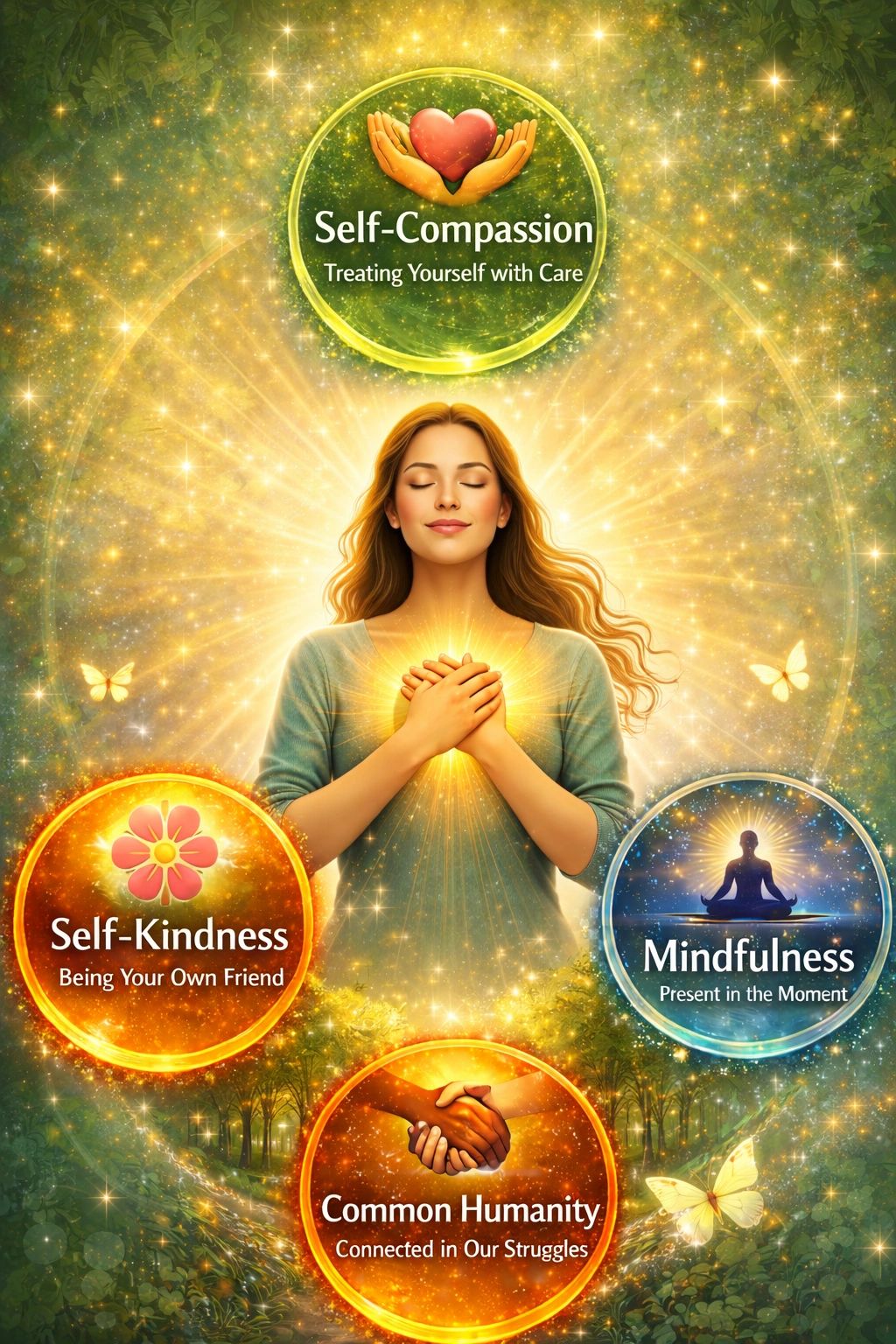
Psychologist Kristin Neff, a pioneer in this field, has spent over two decades researching and defining self-compassion. Her work reveals that self-compassion comprises three interacting components that work together as an integrated system.
Self-kindness versus self-judgment: This involves treating ourselves with warmth, patience, and understanding when we face difficulty or failure, rather than attacking ourselves with harsh criticism. It means responding to our own pain the way we would respond to the suffering of someone we love.
Common humanity versus isolation: This means recognizing that suffering, imperfection, and failure are part of the shared human experience, not something that separates us from others. When we struggle, we often feel uniquely broken or alone. Self-compassion reminds us that this is simply what it means to be human.
Mindfulness versus over-identification: This involves holding our painful thoughts and feelings in balanced awareness rather than suppressing them or becoming consumed by them. We see our suffering clearly without exaggeration, and without letting it define our entire identity.
These three components function as an interconnected system, each supporting and enabling the others. Self-kindness without common humanity can drift into self-indulgence. Common humanity without mindfulness can become avoidance of personal responsibility. Mindfulness without self-kindness can become cold detachment. When all three operate together, they create a resilient internal system capable of meeting difficulty with both clarity and warmth.
The Shadow Side: How Lack of Self-Compassion Shows Up
Before we can fully appreciate the power of self-compassion, we must understand what happens in its absence. The lack of self-compassion does not simply leave a neutral space. It actively creates suffering through patterns that may feel so familiar we no longer recognize them as problems.
The Relentless Inner Critic
Perhaps the most common manifestation of low self-compassion is a harsh inner critic that maintains a running commentary of judgment. This voice evaluates everything: your work, your appearance, your social interactions, your parenting, your productivity. "You should have done better." "What's wrong with you?" "Everyone else manages this easily." "You're such a failure."
Research demonstrates that people who engage in chronic self-criticism face significantly elevated risks for depression, anxiety, and stress-related disorders. This is not merely correlation. The neurological mechanisms are well understood: self-criticism activates the brain's threat defense system, triggering the same stress hormones we would experience if we were under verbal assault from another person. In essence, we become our own abuser, and our nervous system responds accordingly.
The cruelest irony is that many people believe their inner critic helps them. They fear that without harsh self-judgment, they would become complacent, lazy, or blind to their flaws. Yet the research shows precisely the opposite: self-criticism undermines the motivation and emotional stability needed for genuine growth and sustained effort.
The Perfectionism Trap
Perfectionism and lack of self-compassion often travel together. The perfectionist sets impossibly high standards, then punishes themselves mercilessly for falling short, as all humans inevitably do. This creates a vicious cycle: the fear of failure leads to procrastination or paralysis; any actual mistakes trigger intense self-criticism; the resulting shame and anxiety make future performance worse; which then seems to justify even harsher standards.
Multiple studies confirm that self-compassion moderates the link between perfectionism and depression. For individuals with higher self-compassion, perfectionist tendencies are less likely to spiral into psychological distress. They can hold high standards without those standards becoming weapons of self-destruction. Without self-compassion, however, perfectionism becomes toxic, contributing to chronic stress, burnout, relationship difficulties, and mental health disorders.
Isolation and the Myth of Unique Brokenness
When we lack self-compassion, our struggles feel uniquely shameful. We look around and see others who appear to have their lives together, who seem to navigate challenges with ease, who do not seem plagued by the doubts and difficulties that torment us. This perception, though almost always inaccurate, creates profound isolation.
Consider imposter syndrome, that pervasive feeling of being a fraud who will eventually be exposed. A recent study of over 1,200 doctoral students found that impostor phenomenon was widespread and strongly linked to mental distress, including anxiety, depression, and loneliness. However, the study also found that self-compassion served as a powerful buffer. When self-compassion was added to statistical models, the association between imposter feelings and psychological distress was significantly reduced or even eliminated.
The truth is that most people feel inadequate at times. Most people struggle. Most people have doubts about whether they truly belong or deserve their successes. Self-compassion, through its component of common humanity, connects us to this shared experience and lifts the burden of imagined uniqueness.
Emotional Dysregulation and Rumination
Without self-compassion, difficult emotions become overwhelming. We either suppress them (leading to eventual explosions or psychosomatic symptoms) or become consumed by them (leading to rumination and emotional flooding). The psychologist Kristin Neff describes this as "over-identification," a state where our painful thoughts and feelings take over our entire sense of self.
Rumination, that endless mental replay of negative events and self-critical thoughts, is particularly damaging. It is one of the strongest predictors of depression and anxiety, and it is directly linked to low self-compassion. Research shows that self-compassion reduces rumination after anxiety-provoking social events by helping people become more cognitively flexible, more open to their emotional experience, and less overwhelmed by their emotions.
Physical Health Consequences
The damage from chronic self-criticism extends beyond mental health. The constant activation of the threat response system takes a physical toll. Research links low self-compassion to sleep disturbances, weakened immune function, increased inflammation, and greater vulnerability to stress-related illness. A comprehensive meta-analysis examining nearly 30,000 participants found that self-compassion predicted outcomes across multiple health domains, with particularly strong effects on global physical health, functional immunity, and sleep quality.
Self-criticism habits can cause insomnia, leading to less energy during the day and less resilience when facing challenges. The body keeps the score, as trauma researcher Bessel van der Kolk famously observed. When we treat ourselves as the enemy, our physiology responds as if we are under perpetual attack.
Relationship Difficulties
People who lack self-compassion often struggle in their relationships as well. They may hold others to the same impossible standards they hold themselves, creating tension and conflict. They may have difficulty receiving love, compliments, or support, believing at some level that they do not deserve kindness. They may be so depleted by their internal battles that they have little emotional energy left for connection.
Research by Neff and others has found that self-compassionate individuals tend to be more caring, supportive partners. They are less reactive, more empathic, and better able to balance their own needs with the needs of others. This makes intuitive sense: we cannot sustainably give to others what we refuse to give ourselves.
Why Self-Compassion Works: The Science
The evidence for self-compassion is not merely correlational. Meta-analyses of randomized controlled trials consistently find that self-compassion interventions produce significant improvements in psychological wellbeing. A recent meta-analysis found that self-compassion interventions had medium effects on reducing depressive symptoms and stress, and small but significant effects on reducing anxiety. These effects persisted at follow-up assessments, suggesting lasting change rather than temporary relief.
The mechanisms are increasingly well understood. Self-compassion appears to work through several pathways: it reduces activity in the brain's threat system while activating the care-giving and attachment systems; it promotes emotional regulation by creating a safe internal space from which to approach difficult feelings; it interrupts the cascade of rumination and self-criticism that maintains depressive and anxious states; and it builds psychological resources like resilience and adaptive coping.
Importantly, self-compassion provides psychological benefits that self-esteem cannot. Self-esteem is inherently evaluative and comparative. It requires us to feel special or above average, which by definition not everyone can achieve. It fluctuates with our successes and failures, making it an unstable foundation for wellbeing. Self-compassion, in contrast, does not depend on evaluation or comparison. It is available in moments of failure precisely when we need it most.
Addressing the Fears
Despite the evidence, many people resist self-compassion. These resistances are worth examining directly, because they often reflect the very self-critical patterns that self-compassion aims to heal.
"It will make me complacent or lazy." This is perhaps the most common fear, and the research directly contradicts it. Self-compassion does not undermine motivation; it transforms motivation from a fear-based, avoidant form to an approach-based form rooted in genuine desire for growth. Self-compassionate individuals are more likely to take personal responsibility for their mistakes, try again after failure, and engage in healthy behaviors.
"It means letting myself off the hook." Self-compassion does not mean avoiding accountability. It means holding ourselves accountable from a caring stance rather than a condemning one. We can recognize our mistakes clearly, learn from them, and commit to doing better, all without the added burden of self-abuse.
"It is just self-pity." Self-pity is passive, overly self-focused, and disconnecting. It wallows in suffering without seeking to address it. Self-compassion is active, balanced, and connecting. It acknowledges suffering, places it in the context of shared human experience, and motivates caring action.
"I do not deserve it." This fear is perhaps the most poignant, and it often stems from early experiences of shame, criticism, or conditional love. Yet self-compassion does not require worthiness. It is offered precisely because we are suffering, not because we have earned the right to kindness. The very belief that we do not deserve compassion is itself a form of suffering that calls for a compassionate response.
Cultivating Self-Compassion: Beginning the Practice
Self-compassion is not a personality trait fixed at birth. It is a skill that can be developed through practice. While a full treatment is beyond the scope of this article, several entry points are worth noting.
The Self-Compassion Break: In moments of difficulty, pause and acknowledge that this is a moment of suffering (mindfulness), remind yourself that struggle is part of the shared human experience (common humanity), and offer yourself words of kindness (self-kindness). This simple practice, developed by Kristin Neff and Christopher Germer, can be done in under a minute and gradually rewires our habitual responses to difficulty.
The Friend Perspective: When you notice harsh self-criticism, ask yourself: "What would I say to a good friend in this situation?" Then offer those same words to yourself. The gap between how we treat others and how we treat ourselves often reveals the depth of our self-compassion deficit.
Compassionate Writing: Research shows that writing about difficult experiences from a self-compassionate perspective produces significant benefits. Writing to yourself as you would write to a dear friend going through the same struggle can help internalize a more compassionate inner voice.
Loving-Kindness Meditation: This ancient practice involves systematically directing wishes of wellbeing toward oneself and others. Studies show that even brief loving-kindness practices can increase positive emotions, social connection, and compassionate responses. A recent study found that just 10 minutes of loving-kindness meditation produced measurable improvements in well-being and feelings of connection.
The Larger Vision
Self-compassion is not ultimately about self-improvement, though improvement often follows. It is about a fundamental reorientation in how we relate to ourselves and our experience of being human. It invites us to recognize that we are deserving of kindness not because of what we achieve or how we perform, but simply because we exist and because we, like all beings, wish to be happy and free from suffering.
The practice has a beautiful paradox at its heart. When we stop attacking ourselves for our inadequacies, we often find that change becomes easier, not harder. When we accept ourselves as we are, we create the safety needed for genuine growth. When we treat ourselves with kindness, we have more kindness to offer others.
As Thupten Jinpa, the developer of Compassion Cultivation Training at Stanford, writes, cultivating a "fearless heart" means developing the courage to meet suffering, both our own and others', with compassion rather than fear. This courage transforms not only our inner life but our capacity to engage with a world that desperately needs more kindness.
Self-compassion is not a luxury or an indulgence. It is a necessity for sustainable wellbeing, for resilient performance, and for the capacity to genuinely care for others. The research is clear. The practices are accessible. The only question is whether we will offer ourselves what we so readily offer others: the simple gift of kindness in the face of struggle.
_______________
"Treating ourselves kindly is not about lowering our standards. It is about finally having a relationship with ourselves that makes genuine growth possible."
Selected References and Further Reading
Neff, K. D. (2003). Self-Compassion: An Alternative Conceptualization of a Healthy Attitude Toward Oneself. Self and Identity, 2(3), 223-250.
Neff, K. D. (2011). Self-Compassion: The Proven Power of Being Kind to Yourself. William Morrow.
Ferrari, M., Hunt, C., Harrysunker, A., Abbott, M. J., Beath, A. P., & Einstein, D. A. (2019). Self-Compassion Interventions and Psychosocial Outcomes: A Meta-Analysis of RCTs. Mindfulness, 10(8), 1455-1473.
Seppala, E. M., Hutcherson, C. A., Nguyen, D. T., Doty, J. R., & Gross, J. J. (2014). Loving-kindness meditation: A tool to improve healthcare provider compassion, resilience, and patient care. Journal of Compassionate Health Care, 1(1), 5.
Jinpa, T. (2015). A Fearless Heart: How the Courage to Be Compassionate Can Transform Our Lives. Hudson Street Press.
Clarke, B. J., & Hartley, M. T. (2025). Exploring relationships between self-compassion, impostor phenomenon, and mental health among doctoral students. Frontiers in Psychology, 16, 1669075.
Phillips, W. J. & Hine, D. W. (2021). Self-compassion, physical health, and health behaviour: A meta-analysis. Health Psychology Review, 15(1), 113-139.
Marshall, S. L., Parker, P. D., Ciarrochi, J., Sahdra, B., Jackson, C. J., & Heaven, P. C. L. (2018). Self-compassion moderates the perfectionism and depression link in both adolescence and adulthood. PLOS ONE, 13(2), e0192022.