The Science of Caring WellJanuary 27, 2026 · 6 min read
In a fascinating RSA talk, author Daniel Pink presents research that challenges everything we thought we knew about motivation. The findings carry profound implications for healthcare, where burnout has reached crisis levels and traditional approaches to "fixing" exhausted clinicians continue to fail.
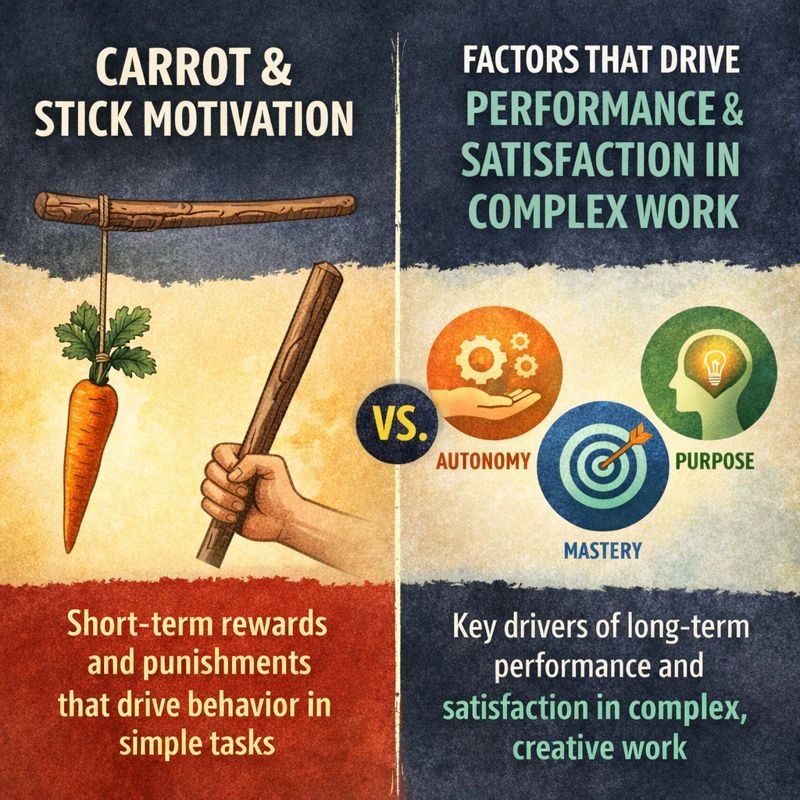
The central insight is deceptively simple yet revolutionary: for complex, cognitive work, higher rewards often lead to worse performance. The carrot-and-stick approach works fine for simple, algorithmic tasks. Follow the steps, get the right answer, receive the reward. But the moment work requires even rudimentary cognitive skill, creativity, or judgment, those same incentives backfire spectacularly.
Healthcare is not algorithmic work. Every patient encounter requires clinical reasoning, empathetic engagement, and nuanced decision-making. Yet healthcare systems continue to rely primarily on carrots (productivity bonuses, patient satisfaction scores) and sticks (disciplinary action, performance improvement plans) to motivate their workforce. Is it any wonder burnout has become epidemic?
The Three Pillars of Intrinsic Motivation
Pink identifies three factors that drive performance and satisfaction in complex work: autonomy, mastery, and purpose.
Autonomy is our desire to direct our own lives. Traditional management, Pink notes, is great for compliance but terrible for engagement. When people doing sophisticated work can be self-directed, results improve dramatically. Software company Atlassian discovered that giving developers one day of pure autonomy, where they could work on anything they wanted with anyone they chose, produced more innovations than months of managed projects.
Mastery is our urge to get better at what matters. Pink points to the phenomenon of skilled professionals spending their limited free time on challenging volunteer work, often doing equally or more sophisticated tasks than in their paid employment. Why? Because getting better at something that matters is intrinsically satisfying.
Purpose is the yearning to contribute to something larger than ourselves. Pink argues that when profit becomes unmoored from purpose, organizations produce what he bluntly calls "crappy products, lame services, and uninspiring places to work." The companies that flourish are animated by purpose.
The Striking Overlap with Well-being Science
What makes Pink's framework particularly relevant for addressing healthcare burnout is how precisely it maps onto Carol Ryff's six-factor model of psychological well-being, a framework increasingly used to understand burnout as a systems failure rather than individual weakness.
Ryff identified six dimensions essential for human flourishing: self-acceptance, positive relations with others, autonomy, environmental mastery, purpose in life, and personal growth. Notice the overlap?
Pink's Autonomy = Ryff's Autonomy. Both frameworks recognize that self-direction is fundamental to human thriving. Research confirms that autonomy-supportive management decreases burnout risk and promotes self-actualization, self-esteem, and general well-being. When healthcare professionals experience chronic threats to their autonomy through rigid productivity requirements, micromanagement, and endless compliance mandates, this pillar of well-being crumbles.
Pink's Mastery = Ryff's Environmental Mastery + Personal Growth. The satisfaction of becoming competent, of managing one's environment effectively, and of continuing to develop represents two of Ryff's six dimensions. When clinicians feel stagnant, when learning opportunities disappear, when the work environment offers no pathway to growth, the well-being system loses its forward momentum.
Pink's Purpose = Ryff's Purpose in Life. Purpose represents the animating force that sustains motivation through difficulty. Research on healthcare professionals consistently finds that a fundamental sense of meaningful work is essential for job satisfaction and burnout prevention. When administrative burdens, moral distress, or organizational dysfunction disconnect professionals from the meaningful aspects of their work, this pillar collapses.
Healthcare Is Heuristic Work
Pink makes a crucial distinction between algorithmic and heuristic tasks. Algorithmic tasks have a clear path to a correct solution. Heuristic tasks require experimentation, creativity, and judgment because no single answer exists.
Healthcare is profoundly heuristic. Every patient brings a unique combination of physiology, psychology, history, values, and preferences. Clinical reasoning requires integrating incomplete information, managing uncertainty, and making judgment calls in real time. Communication requires reading emotional cues, adjusting approaches, and building therapeutic relationships unique to each encounter.
Yet healthcare organizations often manage clinicians as if their work were algorithmic: measure the widget, hit the target, get the reward (or avoid the punishment). This fundamental mismatch between how the work actually operates and how organizations attempt to motivate performance helps explain why so many well-intentioned initiatives fail.
Burnout as Systems Failure
W. Edwards Deming observed that our world is perfectly arranged to produce our current results. When healthcare professionals experience burnout, we must resist the temptation to attribute their suffering to personal weakness or insufficient resilience. Instead, we must recognize burnout as evidence that the systems designed to support human well-being have failed.
The interconnected nature of Ryff's dimensions means that dysfunction in one area cascades throughout the system. A professional who loses autonomy may begin to question their purpose. Someone whose mastery is constantly undermined may lose the environmental competence necessary for self-acceptance. When the system fails to support these fundamental human needs, burnout becomes not just likely but inevitable.
Pink's research suggests a different approach. Instead of asking "How do we incentivize better performance?" organizations should ask "How do we remove the barriers to autonomous, purposeful work that allows people to develop mastery?"
Practical Implications
The research points toward several shifts in how we approach the healthcare workforce's well-being:
Pay people enough to take money off the table. Pink notes that the best use of money as a motivator is to pay people enough that they stop thinking about money and start thinking about the work. Compensation stress undermines all three intrinsic motivators.
Protect autonomy fiercely. Every policy, procedure, and requirement that removes professional judgment should be scrutinized. The question is not "Does this ensure compliance?" but "Does this support or undermine autonomous professional practice?"
Create pathways for mastery. Continuing education should be protected, not seen as overhead. Clinical ladder programs, specialty certifications, and opportunities for teaching all support the mastery dimension. When organizations strip these opportunities in the name of productivity, they damage a fundamental pillar of sustainable motivation.
Connect work to purpose daily. Healthcare professionals chose this field because they wanted to help people. Administrative burden, moral distress, and organizational dysfunction all interrupt this connection. Leaders must work actively to keep purpose visible and accessible.
Recognize burnout as a systems problem. When clinicians burn out, the reflexive response is often individual intervention: counseling, resilience training, wellness apps. While these may help, they cannot substitute for addressing the systemic factors that make burnout predictable. As Deming taught, if you want different results, you must change the system.
The Path Forward
Pink concludes his talk with a vision: "If we start treating people like people, not assuming that they're simply horses (slower, smaller, better-smelling horses), if we get past the ideology of carrot and stick and look at the science, we can build organizations and work lives that make us better off."
For healthcare, this means building systems that support rather than undermine the fundamental human needs for autonomy, mastery, and purpose. It means recognizing that burnout is not a failure of individual resilience but evidence of systemic dysfunction. It means applying the science of motivation to create conditions where healthcare professionals can thrive.
The research is clear. The path forward is illuminated. The question is whether we have the collective will to build healthcare systems worthy of the people who dedicate their lives to caring for others.
References
Pink, D. (2010). The surprising science of motivation [Video]. RSA. https://www.youtube.com/watch?v=u6XAPnuFjJc
Khammissa, R. A. G., et al. (2022). The burnout construct with reference to healthcare providers: A narrative review. SAGE Open Medicine, 10.
Ryff, C. D. (1989). Happiness is everything, or is it? Explorations on the meaning of psychological well-being. Journal of Personality and Social Psychology, 57(6), 1069-1081.
Ryff, C. D., & Keyes, C. L. M. (1995). The structure of psychological well-being revisited. Journal of Personality and Social Psychology, 69(4), 719-727.